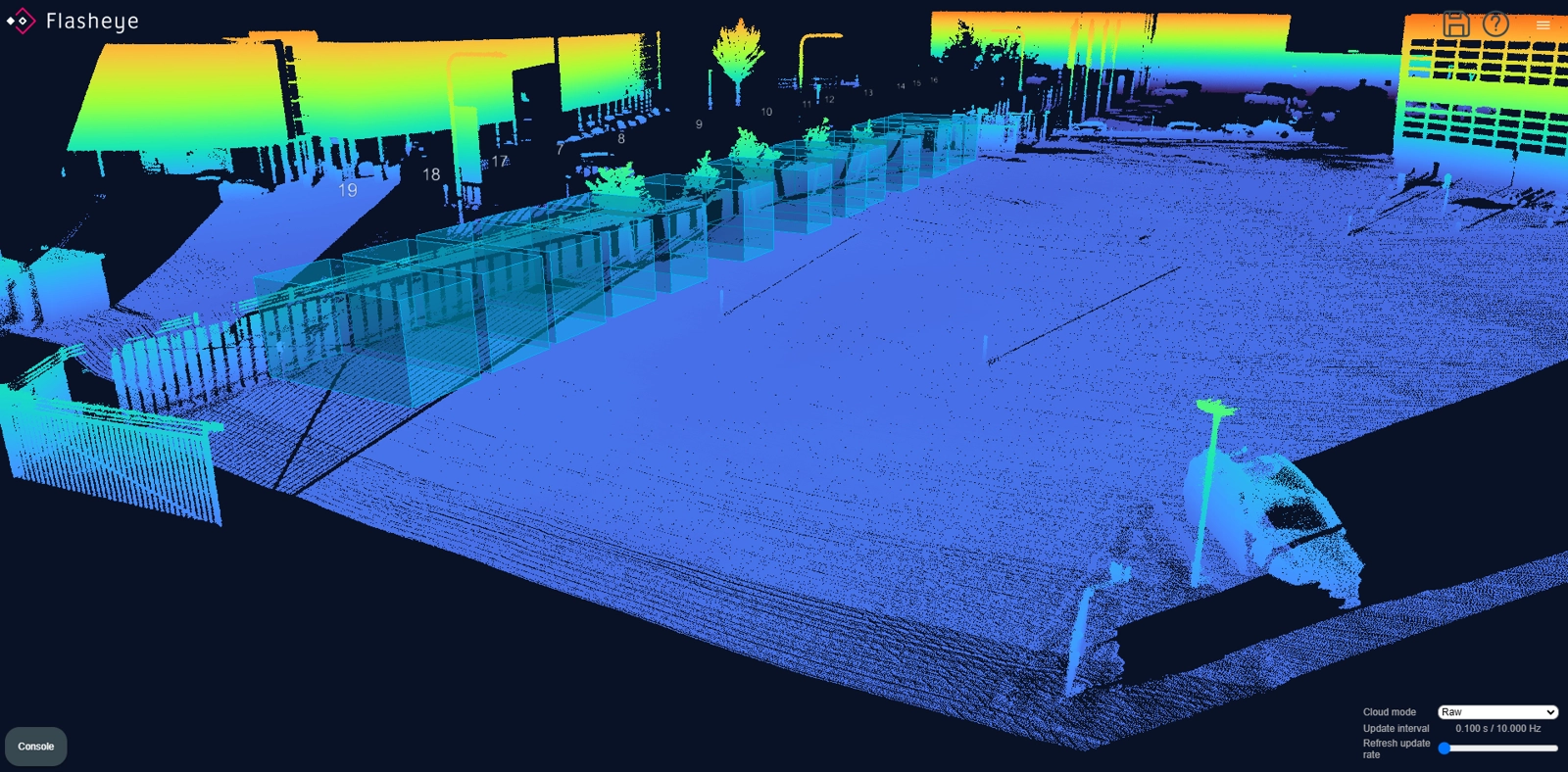
We Bring Awareness to Machines, Systems, and Humans Through Real-Time 3D Perception.
Achieve Autonomous Excellence.
Where it started
Flasheye is founded 2019 in Kiruna, by Ulf Lindström who has long experience within industry and infrastructure.
The idea came from the needs of mining companies and process plants, to access a robust monitoring system that are both reliable and rich of high-quality data, to take the major steps towards automation, autonomy, and safety.
Tests and evaluation results showed that 3D sensors are the most promising technology to detect changes, motions, deviations, leakages, and spillage. Another factor is that the prices of the hardware are expected to decrease dramatically in the coming years.
Another challenge is that every environment is unique. Therefore, the first solution is the hardware-agnostic software toolbox for 3D sensors with plug-and-play analytics and integrations. Like a swiss army knife.
Trust
Trust hinges on leadership's transparency and accountability, alongside flexibility in client solutions. This fosters a reliable and adaptive environment, essential for long-term partnerships and innovative solutions.
Innovativeness
Flasheye aim to be in the forefront of 3D perception software to provide expert support to global leaders of products, systems, and manufacturers. The team has deep experience from industry, automation, robotics, 3D sensors, and software development along groundbreaking patents for upscaling the technology.
Challenger
We disrupt established norms, driven by our vision for a future enhanced by autonomous systems. It's not the easiest path, but we believe in empowering people with revolutionary, efficient solutions.
So what does Flasheye do..??
They provide Perception Software for lidar units. Okay… so what is lidar..??
Lidar, stands for Light Detection and Ranging, is an advanced remote sensing technology that uses light in the form of a pulsed laser to measure distances to a target. Here’s a breakdown of how it works and its applications:
How Lidar Works:
- Emission of Laser Pulses: A laser emits rapid pulses of light towards a target.
- Reflection: The light hits the target and reflects back to the sensor.
- Time Measurement: The system measures the time it takes for the light to return.
- Distance Calculation: Using the speed of light, the system calculates the distance to the target based on the time taken for the light to return.
Key Features:
- High Precision: Lidar can provide very accurate distance measurements, often within a few centimeters.
- 3D Mapping: It can create detailed 3D maps of the environment, capturing the shape and features of the terrain.
- Versatile Applications: Lidar is used in various fields, including:
- Topography: Mapping landscapes and terrain.
- Forestry: Measuring vegetation height and density.
- Urban Planning: Assisting in city planning and infrastructure development.
- Autonomous Vehicles: Helping vehicles navigate by detecting obstacles and mapping surroundings.
Benefits of Lidar:
- Rapid Data Collection: It can cover large areas quickly compared to traditional surveying methods.
- Non-Invasive: Lidar can gather data without disturbing the environment.
- In summary, Lidar is a powerful tool that combines laser technology with data analysis to provide precise measurements and detailed environmental insights.
The Perception Software for any 3D Sensor
Enabling any 3D sensor to perceive, understand, and take action in the physical world to reach your goals within safety, quality, and sustainability.
Outstanding Generation of Highly Valuable Data Streams
Lidar technology generates vast amounts of high-quality 3D data by capturing millions of data points through laser scans. Our lidar perception software transforms the data into auto-labeled objects, alerts and actions. By integrating AI, this system not only provides real-time awareness but also optimizes operations over time, enhancing understanding of trends and patterns. This approach enables both machines and humans to comprehend extensive datasets and make more informed decisions, continuously improving performance and efficiency.
So Flasheye is the software..??
Yes, but how we use it is the interesting thing
We have two different approaches dependant on the processing power required and the onsite facilities available for us to connect to.
We can operate totally independent as a Processing Pod using an industrial PC to provide the analytics engine, server and data manager OR as firmware on our chosen device from Opsys-tech providing output functionality.
Why Opsys LiDAR is the best solution
Opsys’ flexible modular LiDAR approach enables the sensor to be integrated in any position providing additional benefits
Opsys’ patented technology allows point by point scanning which increases ‘signal to noise ratio’ and ‘single point probability of detection’
No moving parts allows 24/7 operation
Processing Pod
Used when the VMS onsite is insufficient to provide end point control or when the distance to an IP or the control room is too great. We will then provide a pod that can not only process the lidar information but act upon it.
Solutions in this realm are Hesai head units and local output to and I/O gang such as an MQTT governor.
ALTOS by Opsys-Tech
Flexibility-Driven Technology
Opsys’ unique approach enables the merging of multiple base sensors into an integrated LiDAR system, providing a single point cloud output. This customizable, yet affordable, solution caters to a myriad of use cases across a diverse range of industries.
Opsys’ patented technology allows point by point scanning which increases ‘signal to noise ratio’ and ‘single point probability of detection’
No moving parts allows 24/7 operation and keeps costs down as systems are extremely robust enabling all industrial processes to be 100% reliable in the long-term.